Bridging the Gap Between Detection and Prediction
AI-powered drone intelligence that puts real-time wildfire situational awareness in the hands of first responders — before the first ground crew ever arrives.
The Wildfire Problem
Wildfire detection and real-time spread prediction remain critically underdeveloped. The tools available today leave first responders with incomplete, delayed, and inaccurate intelligence — and the consequences are catastrophic.
Manned Missions Are Too Slow
Ground crews and aerial reconnaissance by fire departments can take hours to deploy. By the time a manned aircraft reaches a fire zone, conditions have already shifted — making initial spread assessments dangerously outdated before they even reach incident command.
Satellites Can't Be On-Demand
Satellite imagery provides wide-area visibility but with critical gaps. Resolution is often insufficient for the minute terrain and vegetation details needed for accurate spread modeling — and satellites may be orbiting over a completely different region of the globe when a fire ignites, making on-demand coverage impossible.
Prediction Models Are Data-Starved
Accurate fire spread prediction requires dense, real-time data on temperature, humidity, fuel load, and wind across the fire perimeter. Existing solutions can't gather this at the speed and granularity needed — leaving fire behavior models working off estimates rather than live intelligence.
The Fireflyt Approach
Fireflyt addresses wildfire response through a two-tier intelligence platform — combining AI-driven predictive software with autonomous drone hardware to deliver actionable situational awareness from the earliest moments of ignition. Together, these layers give fire departments a continuous operational picture that starts well before any ground crew can deploy and persists long after a fire is contained.
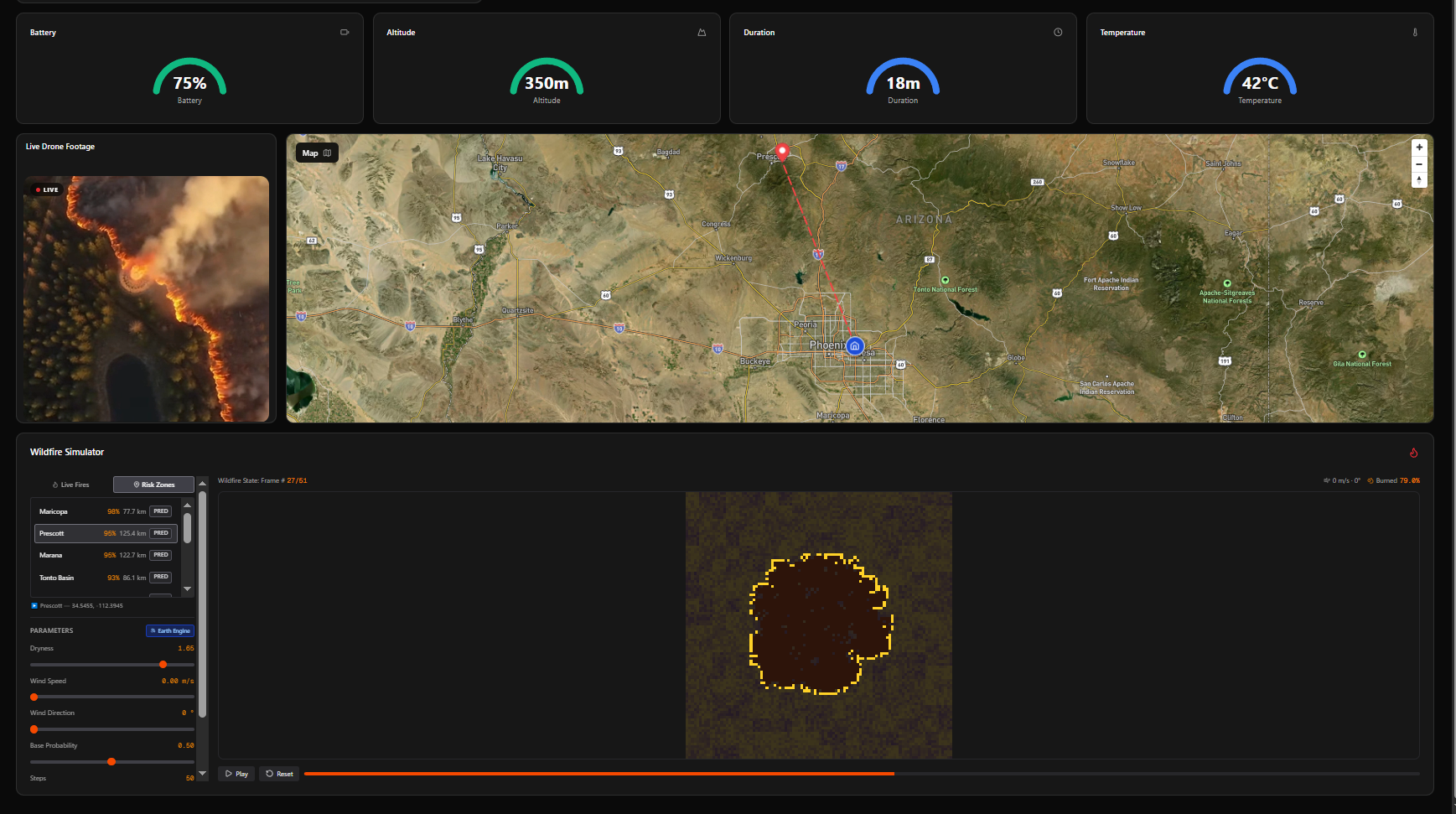
Wildfire Intelligence Dashboard
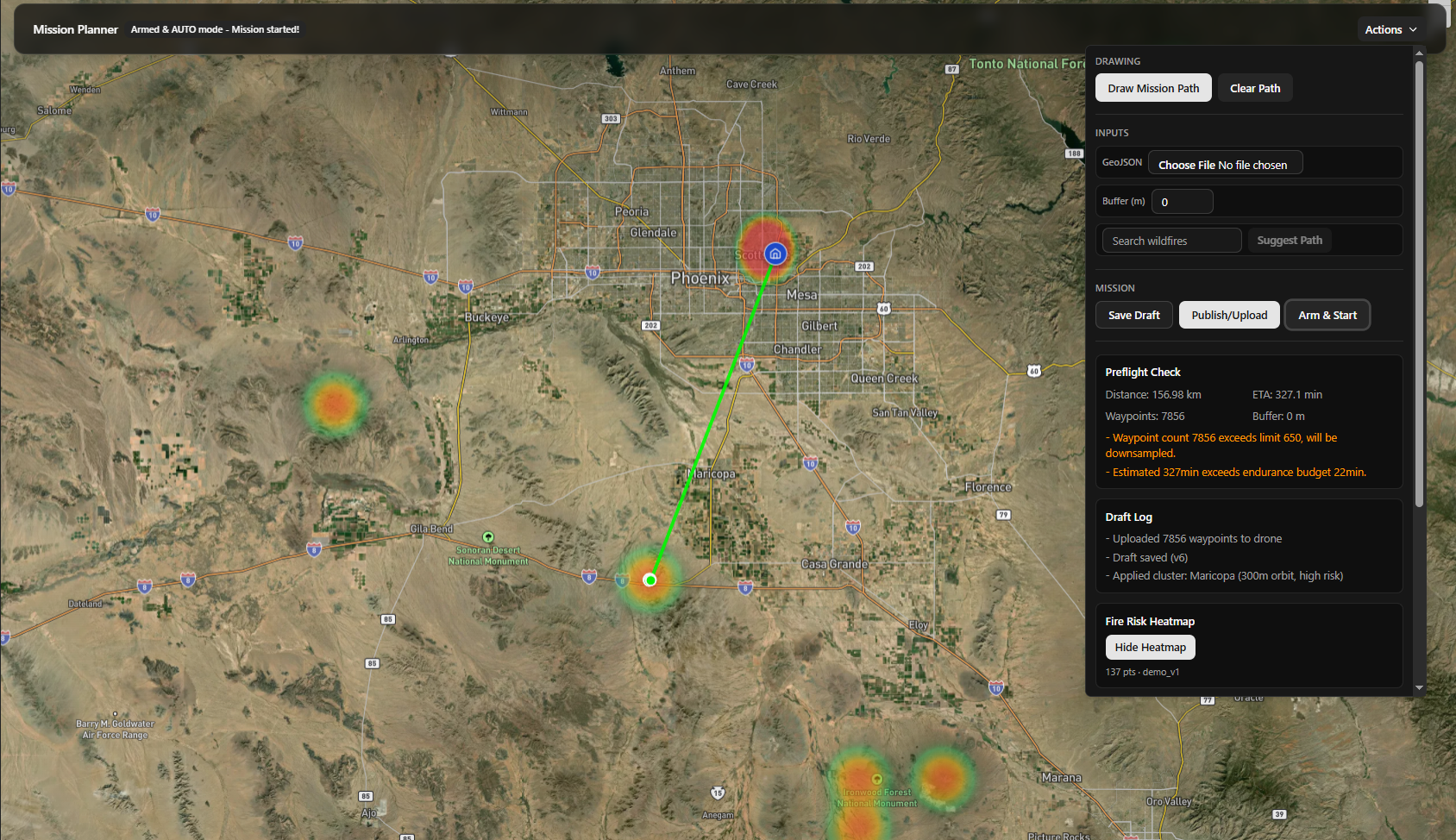
Autonomous Drone Flight Planner
Predictive Intelligence Software
Our software platform gives fire departments and response teams advanced pre-detection and prediction capabilities ahead of any physical deployment. We continuously process live satellite data from NASA FIRMS alongside Google Earth Engine's Alpha Earth Embeddings to assess wildfire ignition risk across proximity zones — surfacing active alerts and risk assessments before a situation escalates.
At the core of the prediction engine, machine learning models trained on historical fire behavior, terrain topology, and real-time environmental conditions generate dynamic spread simulations for fires in your area. These simulations translate directly into tactical intelligence: the estimated closest point of contact with the fire perimeter, windows of minimal spread suitable for safe crew ingress, and a clear operational distinction between actively burning zones and dead, burned-out terrain. As conditions evolve, the platform continuously refines its output — keeping incident command ahead of the fire rather than reacting to it.
- Proximity wildfire risk assessment with live NASA FIRMS alerts
- AI/ML ignition risk modeling using terrain type and environmental data
- Cellular-automata fire spread simulation with configurable wind and dryness parameters
- Tactical analytics: closest point of contact, least-spread windows, active vs. burned zone mapping
Autonomous Drone Deployment
When a wildfire event is identified, Fireflyt dispatches autonomous drones directly to the site — arriving ahead of any ground or manned aerial crews. Each drone is equipped with HD cameras, LiDAR sensors, and thermal imaging, providing continuous multi-spectrum coverage of the fire zone from the moment of first dispatch. There is no manual piloting required; the platform handles navigation, obstacle avoidance, and data relay autonomously from takeoff to landing.
Onboard an NVIDIA Jetson Nano paired with a custom flight controller, each drone performs real-time processing for fully autonomous flight and live data relay. This enables persistent aerial monitoring across the full lifecycle of a wildfire — from initial ignition through active spread and final containment. The intelligence captured becomes a permanent operational record: stored footage of complete fire cycles, high-resolution terrain maps documenting post-fire impact, and analytics that support community recovery and renovation planning for affected areas. Every deployment also feeds back into our models, making future responses faster and more precise.
- Autonomous early dispatch — on-site before any manned crew
- HD cameras, LiDAR, and thermal sensors for multi-spectrum site coverage
- NVIDIA Jetson Nano onboard processing for autonomous flight and real-time predictions
- Full wildfire lifecycle monitoring: ignition, spread, containment, and post-fire terrain mapping
- Structured data for community recovery forecasting and future mission efficiency
Backed by industry leadership

Mentored by General Dynamics
Guided by a global leader in defense and aerospace technology, helping us engineer a platform built to mission-critical standards.
In Collaboration with Scottsdale Fire Department and Police Department
Working directly with Scottsdale Police and Fire Department in Arizona to validate our platform against real-world first-responder operational requirements.

Semifinalists — AWS 10,000 AIDeas
Recognized as semifinalists in the AWS AIDeas competition, selected among top AI-driven ventures for innovation in real-world impact.
Where we originate